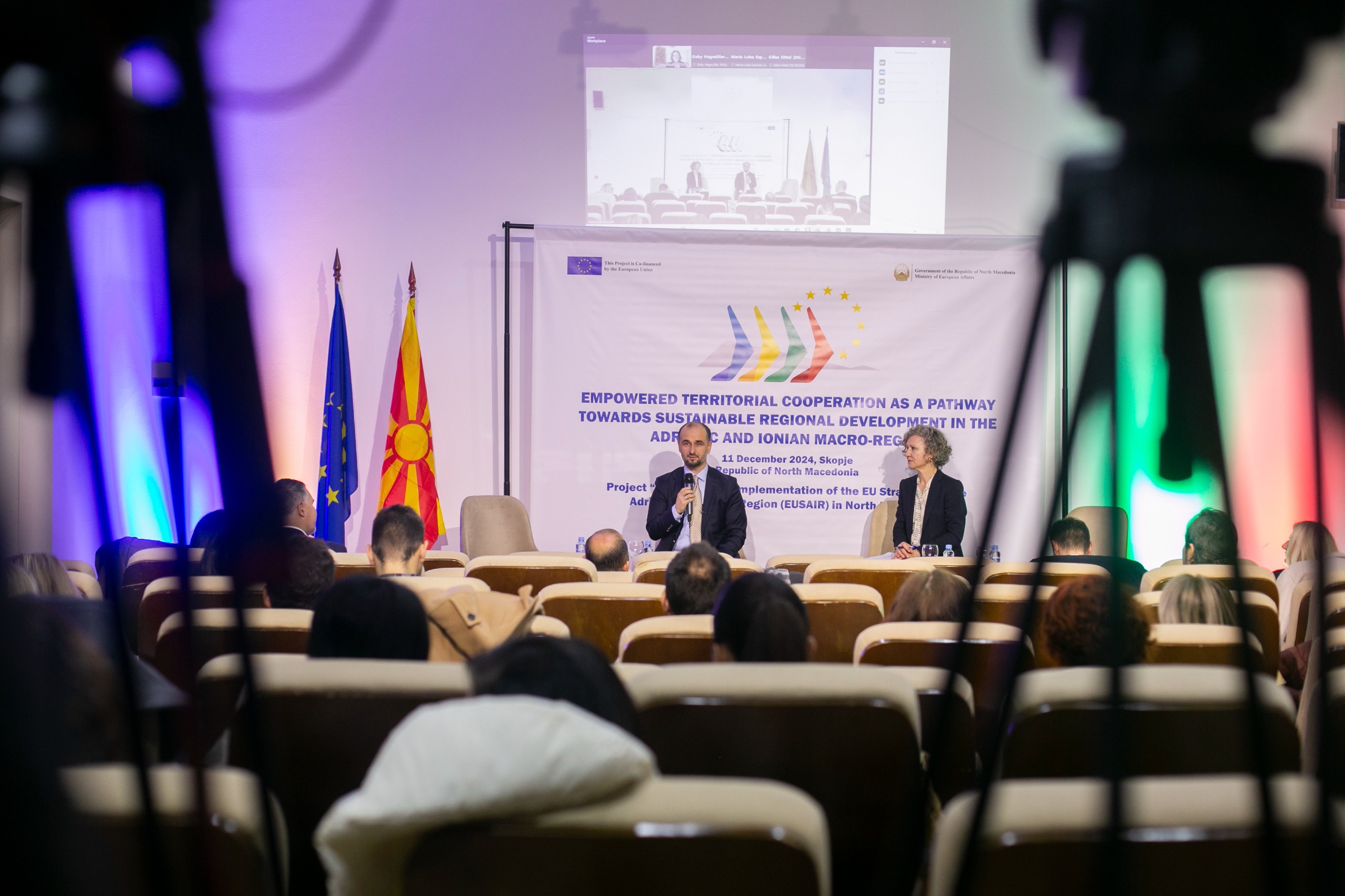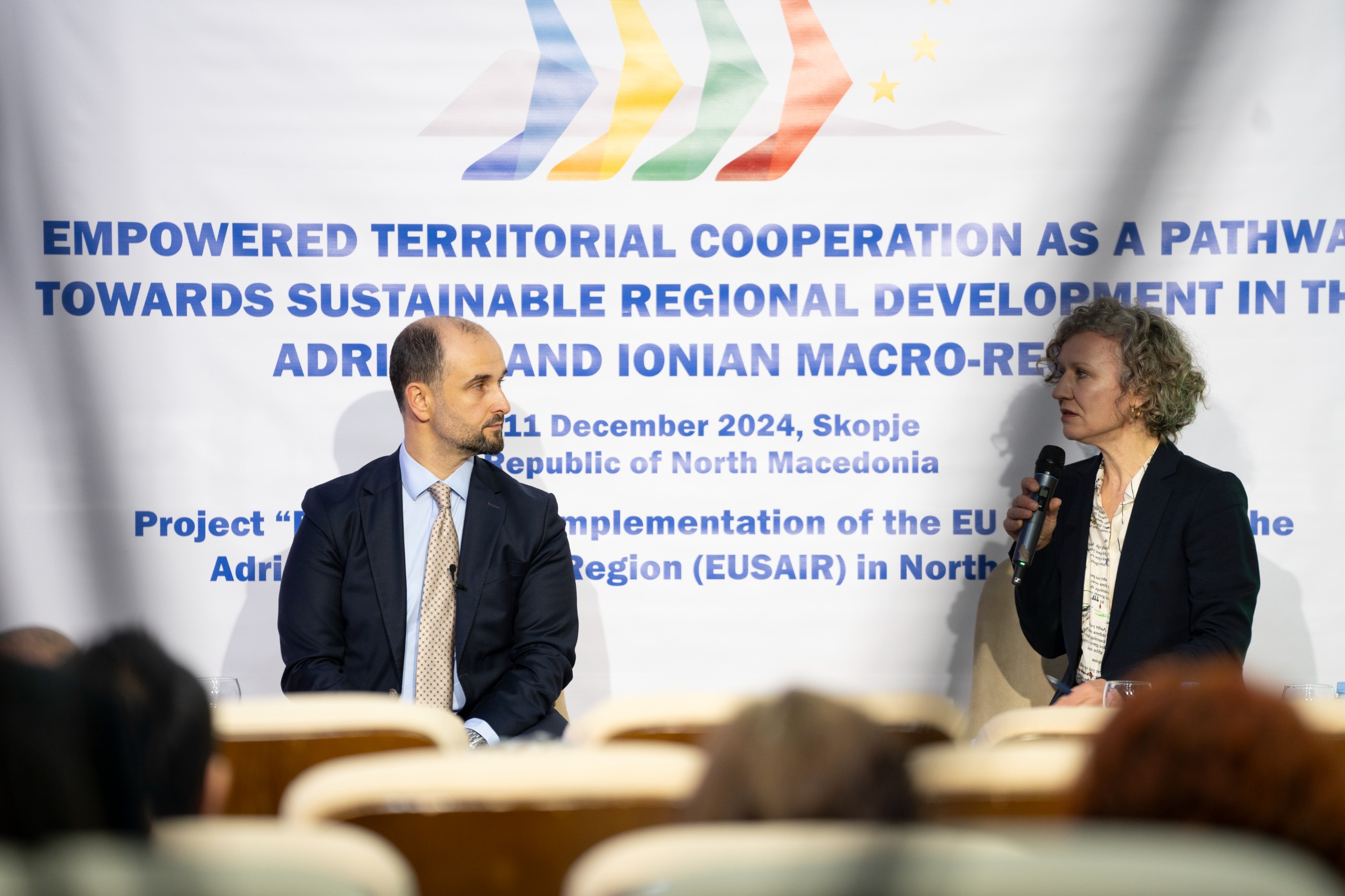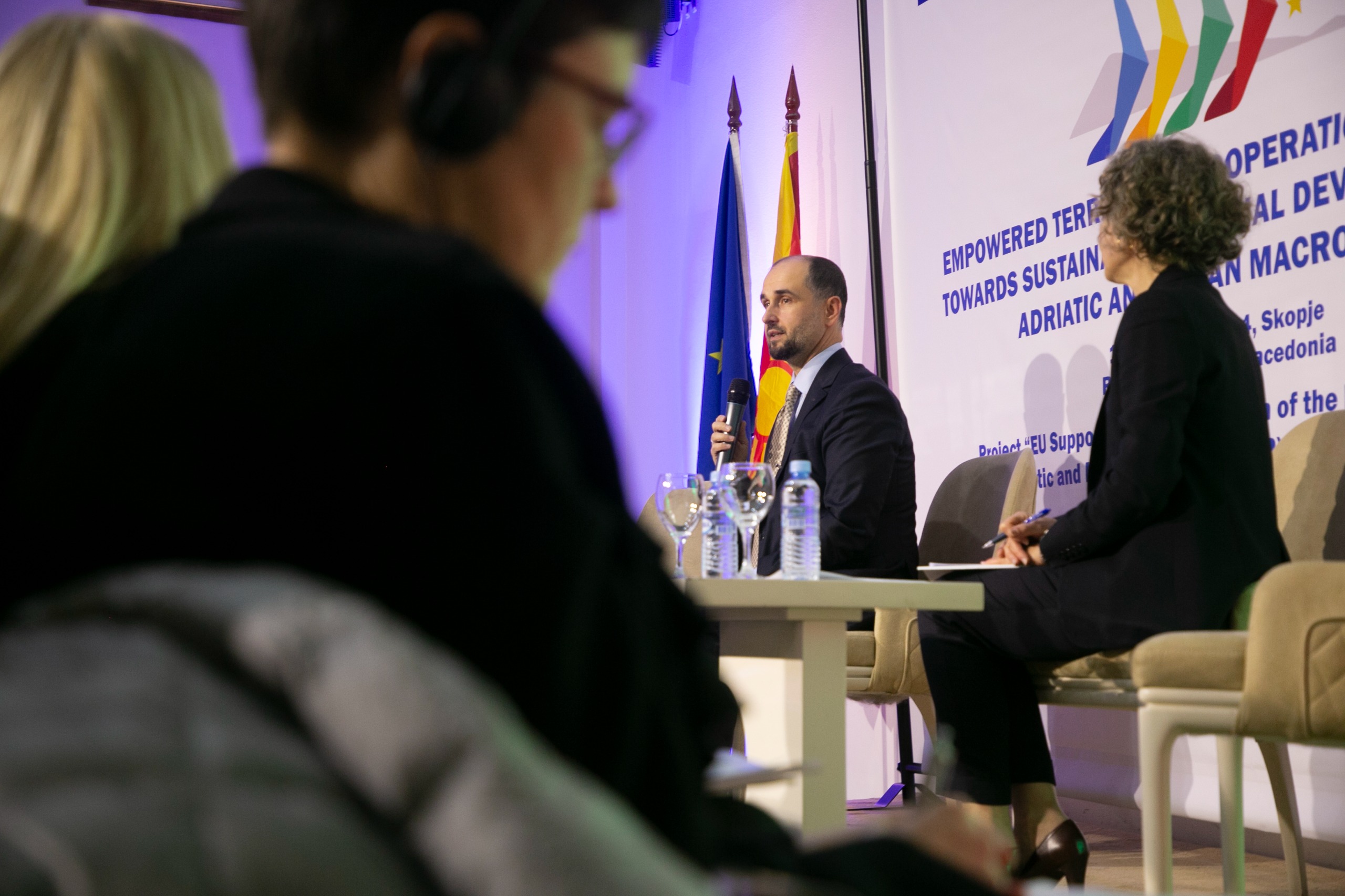
The Minister of European Affairs, Orhan Murtezani, today participated in the final conference of the project "EU Support for the Implementation of the EU Strategy for the Adriatic and Ionian Region in the Republic of North Macedonia", organized by the Ministry of European Affairs of North Macedonia.
In his opening address on the topic "Enhanced Territorial Cooperation as a Path to Sustainable Regional Development in the Adriatic and Ionian Macro-Region", the Minister emphasized that cooperation is the core and essence of solidarity, the promotion of mutual understanding and, undoubtedly, of sustainable regional development. “At the heart of the European project itself lies the commitment to promoting cooperation, building bridges and breaking down the barriers that create borders. This is also the fundamental task of cohesion policy, as a pillar of European integration and as a driver of change, which is particularly relevant for the various forms of cross-border cooperation, where European values are recognised and applied together with all stakeholders at national, regional and local level in the European Union, but also beyond.” – said Murtezani.
The following is the full text of MEP Murtezani’s address:
Dear attendees, esteemed panelists and participants,
Today I have a special honour to address the conference that celebrates the spirit of cooperation and highlights the importance of the Adriatic-Ionian Strategy in creating a common future for our region. This initiative is an example of how joint efforts can transform challenges into opportunities and create new perspectives for our societies.
Cooperation is the core and essence of solidarity, of promoting mutual understanding and, undoubtedly, of sustainable regional development. At the heart of the European project itself lies the commitment to promoting cooperation, building bridges and breaking down the barriers that create borders. This is also the fundamental task of cohesion policy, as a pillar of European integration and as a driver of change, which is particularly relevant for the various forms of cross-border cooperation, where European values are recognized and applied together with all stakeholders at national, regional and local level in the European Union, but also beyond.
There are numerous joint initiatives that follow the internal and external borders of the Union, together with candidate countries and partners from the neighbourhood, among which, but not exclusively, cross-border cooperation programmes, transnational and interregional programmes, as well as macro-regional strategies take their place. Their establishment and continuous improvement and upgrading is a clear indication that territorial cooperation is a serious driving force in terms of economic, social and territorial cohesion.
The conference "Enhanced territorial cooperation as a path towards sustainable regional development in the Adriatic-Ionian macro-region" is taking place at a truly crucial moment, at a time when discussions on the future of territorial cooperation for the period after 2027 are in full swing.
The consultations, which are still ongoing, are largely based on the questions that the esteemed panelists will address today. Their rich professional and personal experience, as well as their connection to the various aspects of territorial cooperation, are a guarantee of a fruitful discussion. I sincerely thank them for their contribution, which I am confident will enrich our understanding and perception of territorial cooperation and stimulate interest in territorial cooperation programmes, the Adriatic-Ionian Strategy and EU cohesion policy in the context of enlargement.
Today’s conference is part of the project “EU Support for the Implementation of the EU Strategy for the Adriatic and Ionian Region in North Macedonia”, funded by the European Commission and implemented by the Ministry of European Affairs. Eight regional and three thematic events with around 400 participants were organised to promote macro-regional strategies. However, they are still not sufficiently known, which limits the improvement of synergy with territorial programmes and the EU national envelope.
Macro-regional strategies do not have their own sources of funding, therefore their inclusion in future EU financial instruments is of key importance. In this context, the Directorate-General for Neighbourhood and Enlargement Negotiations plays a strategic role. The revised Action Plan of the Strategy creates preconditions for better integration in territorial cooperation, while our upcoming presidency of the Strategy will give new impetus to its promotion.
Territorial cooperation programmes, in place for 15 years, offer unique opportunities to address common challenges and build capacity at all levels. However, further efforts are needed to align legislation, develop national strategies and strengthen capacities, especially at local level, to fully exploit the potential of the programmes.