To the European Commission for the preparation of an opinion on the application of the Republic of Macedonia for membership in the European Union
What after the submission of the answers?
An official delegation of the Republic of Macedonia, led by the Prime Minister of the Republic of Macedonia Vlado Buckovski, on 14 February 2005, submitted the answers to the President of the European Commission José Manuel Barroso.
More about the questionnaire
What after the submission of the answers?
An official delegation of the Republic of Macedonia, led by the Prime Minister of the Republic of Macedonia Vlado Buckovski, on 14 February 2005, submitted the answers to the President of the European Commission José Manuel Barroso.
After analyzing the answers and collecting information from other sources, the European Commission prepares an opinion (avis) which it submits to the Council of the European Union. This institution, also known as the Council of Ministers, which is the leading decision-making body of the Union, then submits a proposal to the European Council on whether the country should acquire candidate status and whether to open membership negotiations. The European Council meets every six months at the level of heads of state and government.
What is the questionnaire?
The questionnaire is a form (tool) through which the European Commission collects data on the degree to which the country is prepared for membership in the European Union, and above all for opening membership negotiations. In practice, this means an assessment of the overall social performance of the applicant country. In addition, the Questionnaire is an established instrument and practice through which the positive and negative sides of the applicant country are detected.
The response process
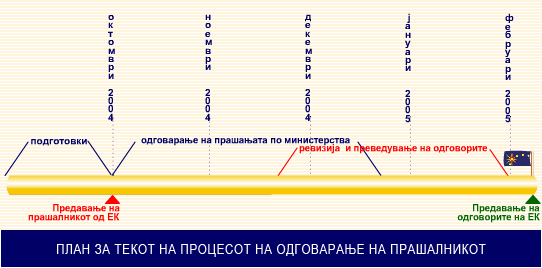
The Government of the Republic of Macedonia set itself a deadline of no more than four months to respond to the questions. With the adoption of the answers by the Government, at a session on 24 January, the process ended even earlier than planned. Previously, all preparations were completed on time. Special structures were established in charge of the process of answering the Questionnaire, and the Government adopted Guidelines, so that all tasks were precisely defined, including uniform rules for answering.
It is extremely important to understand that answering the EC Questionnaire is a process. This means that the work of the Commission does not end after the submission of the questions, nor does the work of the applicant country on the answers end after it submits them to the Commission. There is a possibility for the applicant country to request additional explanations from the Commission and guidelines for answering. On the other hand, it is also customary for the Commission to submit additional questions if it considers that additional data or clarifications are needed on a certain issue.